In December of 2009, I met Terrance Pratt who was one of the first individuals to make “Stepping” a social media phenomenon with the creation of his webpage ChiSteppers.com. Occasionally, I would got out to one of the “hot” clubs in the city to stay connected to friends. I’m reposting this interview I did with ChiStepper.com after Mr. Pratt and I met each other for the first time. Thank you Terrance Pratt.
ChiSteppers, this interview is filled with so many twists and turns that I won’t waste time with an extensive introduction. Reggie discusses everything from talking on the microphone to succumbing and then over coming substance abuse. It’s one of the most in depth interviews I’ve conducted in some time and that’s because Mr. Miles has so many wrinkles to his career. Check it out and share a word or two of feedback if you so choose!
T. Pratt: It was great meeting you at the Dating Game the other day. As I was leaving the club, Fish of the Majestic Gents said, “Reggie Miles was the man.” Speaking of the Gents, you were one of the Original Majestic Gents, right?
Reggie Miles: No, I was never in the Majestic Gents. Fish of the Majestic Gents has known me for years. He was speaking of me as the Legendary DJ. Another of the members of the Majestic Gents, Gregory was the first to acknowledge me as an exceptional DJ and hired me for the group that he was in called the 4 of US. They took Stepping downtown and on the north side of Chicago. There main spot was a place called Karl’s Satin Doll. Their [Steppin set] set the stage for the classy style Steppers sets of today.
TP: Who else was in the organization?
Reggie Miles: The Four of Us were Gregory, Preston, Gerald, and Michael.
TP: Now, I also understand that prior to becoming a Legendary DJ, you were a great Stepper that won the Steppers Contest at Chic Ricks 5 times, even besting a young Pete Frazier in the process.
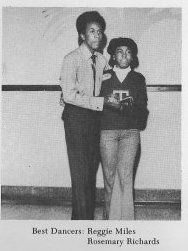
Reggie Miles: Yes, that’s true. I won the Steppers Contest at Mr. Ricky’s “Chic Rick House” 5 weeks in a row with my partner, Janice Morris. After the 5th win, Mr. Ricky asked me if there was something else I could do. I pointed to the DJ Booth and the rest became legend. Pete was always at the Thursday Steppers set at Chic Ricks. He was bringing in what the folks are doing today on the dance floor. I am an original stepper. Pete is a class act on the floor. I was just “smooth.” And my partner Janice Morris was totally in sync with me and it showed on the floor [that] the two of us danced as one.
TP: When did you get started DJing and what role did Sam Chatman play in your development?
Reggie Miles: There were several DJ’s who I admired. I studied them all … Willie Cox, Ernest L., Kenny B. Thompson, Gerald Jones, Don St. James, Big Luke, Butter Ball, Jimmie Lee, and others. I also admired Herb Kent and Richard Pegue but on the Steppers side I give credit to a list of people Gregory Richardson formerly of the Majestic Gents, Richard Willis of The Connection, Mr. Ricky, William Barnett, Luther Gage and the one and only Sam Chatman, another one of my mentors, who called me one of his Sons and asked to spin for him at the Fantasy Lounge because other Steppers told him about me. That’s was great.
TP: Tell us about your days DJing at WKKC.
Reggie Miles: Well, I was the first DJ on WKKC back in September of 1975. My format was “Hits and Dusties.” I was the first student with a 4 hour music show. I had an on and off relationship with WKKC for over 20 years. James Kelly (former PD) and Kevin Brown (former Station Manager) put up with my attitudes and mess over the years and I am truly grateful to them. I was the first “Steppers” DJ on the radio with a Steppers Show before V-103 and Kenny B. Thompson. Of course we were only on the South side but my reputation grew. I made a place for myself between the likes of the great radio personalities like Herb Kent and Richard Pegue, the King and Dr. of Dusties. In 1978 I was the first to play “Love’s Gonna Last” by Jeffery Perry on the radio at WKKC. Love’s Gonna Last became my theme song. After obtaining my Bachelors degree from Columbia College in 1996, I became operation manager of WKKC and then was promoted to Station Manager in 1997. I was the first student from the program to teach a class and become a college lecturer. Two years later I finished my Masters Degree in Media Communications from Governors State University.
TP: When we met you said, “I went from junkie to professor?” What threw you off course?
Reggie Miles: Yes. I fell to alcohol. In 1986, the love of my life, my mother Claudia went on to be with the Lord. I was doing really well with life and was disappointed that my mother could not see my success. I totally immersed myself into the Steppers scène. I kept spinning but I could not spin or dance the pain away. I masqueraded like nothing was going on but inside I was hurting and on a path of self destruction. The results were some of the best sets that EVER happened in Chicago. Nobody knew my pain except those very close to me. I did not face the reality of my mother passing. After running myself into the ground [and] losing everything, I was tired and I could no longer avoid the reality of dealing with my inner pain. Alcohol, Stepping and DJing were no longer the cure or cover up.
TP: How did you recover?
Reggie Miles: Inside of me I knew there was something missing in my life and the only place I knew to go was to God. I found myself attending the Apostolic Church of God where Bishop Arthur M. Brazier is Pastor Emeritus. I saw so many friends and admirers and one of those old friends said just call the name of Jesus. It was one evening and I called on the name of Jesus! And all of a sudden, instantly I was healed. The broken pieces that were scattered about in my life came together. I had control of myself again. I did not want to smoke, drink, spin or go out. I went to church at every opportunity I could. I was a Bible carrying brother. I called myself being under cover going to church on Wednesday nights for Bible Class and that was the best thing I could do but did not realize it. Bishop Brazier, through his message of “Saved by Graced and Grace alone,” helped me to feel comfortable in my own skin. Jesus took care of everything for me and I was a new person. I officially became a member of the Apostolic Church of God on November 6, 1994. Shortly thereafter, I returned to school and finished my college education.
TP: How does a guy go from Steppin, to DJing, to being an award-winning professor at the esteemed Howard University?
Reggie Miles: Through the Grace of God, the Lord had another mission for me. I loved to DJ, I loved Dancing, but God had to take all those things away from me in order for me to see what he wanted me to do. God wanted me to teach and I became an excellent teacher. At Howard, I have an opportunity to study for a PhD if I so desire. The years at WKKC from 1997 to 2003 prepared me in such a way that I became very knowledgeable about radio in general, college radio and training students. Several of my former Kennedy King College students are in radio today, As station manager at WKKC I had to do everything from production to program direction, engineering managing the staff, writing grants, teaching and most of all, training students. In 1995, two months after I became a member of the Apostolic Church of God, I was approached by an engineer in the church. He said to me, “You’re Reggie Miles aren’t you?” I said, “Yes!” He said “Your reputation precedes you; I have something for you to do.” He took me to the television audio recording studio and told me that I was going to be working in the studio as part of the audio ministry for the Apostolic Church of God. I was blown away. I was responsible for the audio heard on the Television broadcasts of one of the most dynamic ministries in Chicago. During my years in the audio ministry I received training from two of the best engineers in audio, Ernie Greene of Sound of Authority and master engineer Danny Leake. The experiences at WKKC and the Apostolic Church of God prepared me for Howard University.
TP: What subjects do you teach at Howard?
Reggie Miles: I teach radio production, advanced radio production and digital multi-track production and I can teach audio for the visual media.
TP: It sounds like you’ve lived a few different lives. Is there a danger to those who dedicate countless hours to the Steppers scene?
Reggie Miles: No, I don’t think so. If that’s what a person wants to do so be it. I will never judge what a person does or does not do. It’s like the parable of the prodigal son. And the great thing about God is that you have a choice, his hand is always extended to you. Stepping is good exercise for the heart. Heck, I wish sometimes that I stayed on the scene because I gained 60 pounds being off the scene.
TP: How do you feel about where Steppin’ has progressed to today?
Reggie Miles: Stepping is great today! Wow! National connections with sets in different parts of the country. That is beautiful. Steppin’ is not only a dance it’s a life style. And the good jocks are getting paid! The one thing that I loved about the Steppers scene was that people dressed to impress and everybody remembered their ABC’s (Always Be Cool). On a Steppers scene it’s all class … Folks dress from the shoes up. When I did get a chance to dance I loved to “slide” and “glide” and you need some good leather on the soles to slide and glide when Stepping.
TP: What are some of the main differences between Steppin now, versus the 70’s and 80’s?
Reggie Miles: That’s a good question; everybody seems to have a different opinion. The differences coincide with the evolution of the music. It was a lot love songs in the 70’s and 80’s and positive music too. Key to World, Love’s Gonna Last, United, My Love is Truly for You. The music was about groups and orchestration. Today it’s beats and soloists. My mother bopped … it was a two or three step swing type thing on the beat of Billy Larkins and the Delegates “Aint That A Groove” or the The Temptations “Girls Alright With Me.” Then the Undisputed Truth hit with “Smiling Faces Sometimes” and a Four Count came out. Now I hear it’s a six and eight count. I am a four count – hand style Stepper – I feel the music. Back in the day, the guys only danced or bopped with one hand. The other hand was at the side with the fist partially clinched with the pinky finger extended. All the players did that and sometimes put the hand behind their back. You had to be careful about how to you held your one hand in different parts of the city. There were Stones, Disciples, Gangsters, Gousters, and Ivy League styles of bopping and each used different hands. So I learned the one hand bop with either hand. The one hand Bop evolved into two-hand Stepping with a four-count beat during the 70’s. The use of “two hands” in the dance arrived and eased the tension from knowing the different one-hand styles. And the great thing about the four-count beat was the versatility which allowed you step on any music tempo. There were several great “slow motion” type steppers. Where the female was working her tail off and the guy seems to be Stepping in slow motion but kept incredible time. I mastered being able to either Walk or Step and not miss a beat on slow songs. That was the cool thing about Stepping in the 70’s and 80’s … one could change from Stepping to Walking during a slow song. Four-count Steppers stepped on any tempo. The Jock’s back in the day directed the floor by saying Steppers on the Inside, Walkers on the Outside. In the 90’s, with the arrival of Ice Ray, Claudell, Pete and others, “High Stepping appeared as Stepping continued to evolve.”
TP: Where will Steppin’ history pay you the most homage, in the area of dancing or DJing?
Reggie Miles: DJing of course. I set the stage for many others. Today, when I come to see old friends, somebody always says, “Man ain’t nobody out here doing it like you did it.” Wow! That is a great tribute to be remembered like that. I started many of the things on the box that are being done today. I blended the music, kept incredible time, always kept the dance floor packed and most of all, I could talk. I entertained and made sure there was a flow in the set. I paid homage to all the Jocks before me. I learned from them all and took the best of what they did and put in my own style. Sam is the greatest at talking to the crowd. He makes everybody feel like they are somebody. All you have to do is walk in and he will recognize you. Sam kept you informed about the music and the artists. I did that too! Sam does what a jock is supposed to do, “Control the Flow in a Set.” Anybody can get behind the box and play records. It takes a special person and character to entertain. Steppers follow certain DJ’s and it’s the DJ’s job to connect with the folk and the only way that can be done is by talking. Now all DJ’s are not as gifted with a vocal presence and that’s okay but don’t hate on those that can talk. A set has a lot of things going on and the DJ needs to be on top of it and be able to speak about it. If you want to hear nonstop music with no talking, listen to your iPod. Everybody in a set is talking anyway, why can’t the DJ? My experience as a radio personality also helped too. I was a combination of street jock and radio personality. I could play for any group. The thing that made me a cut above the rest was that I could Step. And I would not play a song I could not step to.
TP: How does your accomplishment as a Legendary DJ stack up against your accomplishment as an award winning professor?
Reggie Miles: No comparison. The DJing era is over. And as time goes on the memory of me on the Steppers scene will further fade. Maybe one day when I catch up on the new music, I’ll try to play again. The last time I played a set on the scene was at the 3rd Friday set in the 50 Yard Line and a Steppers reporter, Cynthia Bean crucified me for talking. She said I was talking too much! I was not offended, she just did not know who I was. When folks heard my voice they started bringing me their pluggers. I went into my rhythmic style and recognized all the sets in a professional manner in between the music just as my mentor Sam would do. In radio we call it going post to post. As a matter of fact she wrote that I must have thought I was Sam Chatman because I was talking so much. I took that as a compliment. On the other hand, the Howard journey is still in process. Before receiving an Honorable mention for the Teaching with Technology [award] at Howard, I was inducted into the Broadcaster’s Hall of Fame in Akron, Ohio in 2007 for my years as a Gospel Music DJ. I started playing Gospel in 1995. When I arrived in Washington, DC in 2003, I was immediately hired as a part-time on air personality for a Gospel radio station, Heaven 600. And recently in September 2009, I received a Gospel Gold Star “Labor of Love” Award from the Christian Tabernacle Church in Chicago, Illinois. In addition, I have represented myself and Howard University at a number Communication Conventions presenting my research on Podcasting. In February 2010, I will lead a team of Howard faculty and students to North Carolina A&T University to commemorate the 50th Anniversary of the A&T Four and The Greensboro “Sit In Movement.” These things along with my written publications will be preserved and available for research. And to God be the Glory for all the success at Howard. In Chicago, I’m DJ Reggie Miles. In DC, I’m Professor Reggie Miles.
TP: Thanks so much for joining me on the Nation’s Home For REAL Steppers and sharing your incredible story. Is there anything that you’d like to say in closing that maybe I’ve forgot to ask?
Reggie Miles: Thank you for the opportunity to relate my testimony. Stepping has changed a whole lot. And I applaud your effort by taking it to the web. Thanks to everybody that remembers me and I wish all of you the best in your lives. At the sets, I’d like hear more Walking music and the DJ’s taking more command by telling folk “Walkers on the Outside” and “Steppers on the Inside.” And most of all we have to teach the younger generation the beauty of the art form of Stepping and etiquette of the Steppers scene. It’s no drama, just dancing and the coolest lifestyle.
Take care Reggie. You’re welcome back anytime sir!



 The Society of Boppers, Walkers & Steppers